FinLit Newsletter · 2 min read
FinLit Newsletter 10-25-2023
GDP is coming out this week, and it should be a hot one. Here is what to expect from this week's numbers and reaction.
TLM Research
Published · Updated

GDP out this week – what to expect
Tomorrow, third quarter growth numbers will be released. This release will be particularly anticipated, since, as we’ve been noting, we’re standing at a bit of an inflection point. The economy hasn’t operated in such a straight-line fashion; instead, inflation has come down from highs, but stalled at levels that are still too high. The job market remains tight and consumer spending remains high, but affordability and credit measures are trending in the wrong directions.
Second quarter growth beat expectations by a solid margin, consumer spending remains high per the data, and tomorrow’s number is expected to show a very healthy 4.5% growth (annualized). If comes in at or above this number, we expect markets to drop, as it will give the Fed latitude to raise rates further. If it comes in below this number, we expect markets to rise, as it would lower the probability of aggressive Fed action. The market’s been operating in this way for several years now, demonstrating that a central institution – the Fed, has a bigger impact on asset prices than real market dynamics i.e. if a company makes more stuff, it should be a more desirable asset to purchase and therefore its price should rise.
From the Wall St. Journal:
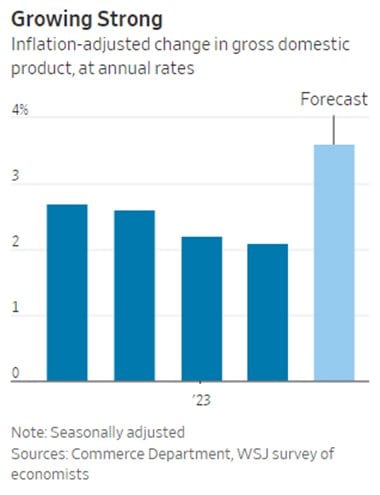
It could be a coupe things happening right now, according to economists:
· Consumers could be returning to their old spending habits after seeing that we’ve gone several quarters now without a hard landing
· Consumers might be optimistic that inflation is coming under control, or at least satisfied with the levels they’re seeing
· This might be a short-lived bump up in optimism, as weekly wages fell in September, the first decline since last May (during that time recession fears were also increased)
o Wage data is often looked at per-hour and weekly – often times, per-hour wages are misleading, because employers can raise wages yet cut hours for workers, so the weekly wage is more of a real indication of how much money workers are taking home. In this case, that happened in September: hourly wages increased, but employers were giving out fewer hours, so the actual weekly take home pay for workers decreased
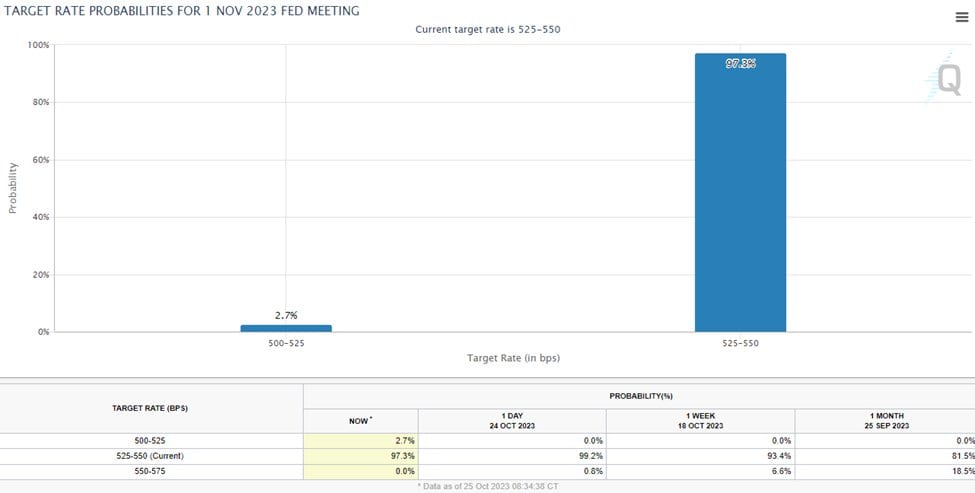
Currently, per the CME Fed Watch Tool, the market thinks it’s virtually certain that rates will remain unchanged during the FOMC meeting next week, with a sliver of sentiment showing rate cuts. It will be interesting to see how this changes – and it definitely will – if growth comes in hot tomorrow.
Included with membership — $49/mo.
Keep reading

FInLit Newsletter 10-27-2023
Q3 GDP numbers are OUT! What doe they look like? And how should you be interpreting them? Let's break it down.
TLM Research

FinLit Newsletter 10-20-2023
Higher for longer interest rates and potentially a new neutral rate. What does that mean for you and the market? Come find out.
TLM Research

FinLit Newsletter 11-1-2023
Another big FOMC meeting is today! What can you expect? What are the projections? Let's dive in.
TLM Research